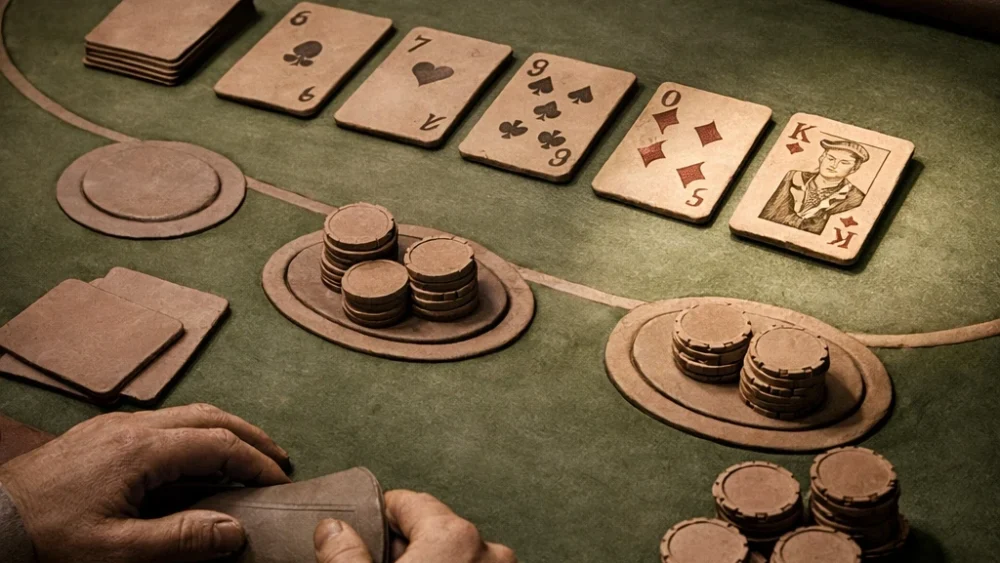
Mississippi Stud is a poker-based casino table game, but it does not play like a contest against a dealer or the other people at the table. Each player is trying to finish with the strongest possible five-card poker hand, and the result is measured against the pay table posted for that game.
That distinction matters. There is no dealer hand to beat and no need to outplay another participant. It is a house-banked game: your result depends on the cards in your hand at the end of the round and the payout attached to that result. The decisions come as cards are revealed, when you choose whether to continue in the round or fold.
What Mississippi Stud is—and what you are playing against
At its core, Mississippi Stud combines familiar poker hand values with a casino-table format. You begin with an ante wager, receive private cards, then see shared cards revealed as the round moves on. The aim is to make the best five-card poker hand possible by the final assessment.
Unlike many casino poker games, the dealer is not building a competing hand. A dealer runs the game and deals the cards, but your hand is evaluated against the game’s pay table. That means the important reference point is the schedule displayed at the table: it sets out the hand results that receive a return and the multiple attached to each one.
It also differs from poker played among a group of players. Other people may be taking part in the same deal, but they are not opponents whose chips you win. Each player’s outcome is determined separately through that player’s final poker result and the applicable pay table.
The practical question throughout a round is therefore not whether another player appears strong. It is whether you want to remain in the hand as the available cards are revealed, under the rules and wager options set for that table.
The cards on the table: private cards and shared cards
Mississippi Stud uses a standard 52-card deck. After the ante has been placed, the dealer gives each player two cards face down. These are the player’s private cards, and the player may examine them before making the next decision.
The dealer also deals three community cards face down before the round develops. Those shared cards are revealed during play rather than being shown all at once at the start. As each reveal changes the picture of the hand, it creates another point at which a player must decide whether to continue.
This layout is what gives the game its gradual rhythm. You begin with only the two private cards in view. Then the shared cards arrive one by one, so the hand is not fully known when the opening wager is made. The final result is assessed as a five-card poker hand.
Private and shared cards serve different roles at the table, but both are central to reading the round. The private cards give you your initial information; the shared-card reveals supply the later information that drives the remaining decisions.
Start with the ante, then follow each reveal
A round starts with an ante wager placed before any cards are dealt. Once you have received and looked at your two face-down cards, play proceeds through the card reveals. At those points, the basic choice is to raise or fold.
The same decision pattern continues as the three shared cards are revealed during the round. A reveal gives you more information about the eventual poker result, after which you decide whether to keep going or leave the hand. This makes Mississippi Stud a decision-based table game rather than a single wager followed by an immediate result.
The exact choices on a particular table deserve attention before you put money down. Betting options, permitted wager sizes at each decision point and the effect of folding are table-specific details that should be read from that game’s posted rules. Do not assume that an option described for another Mississippi Stud table will apply unchanged where you are playing.
The same applies to any optional side bet. Some table games may present additional wagers alongside the ante, but whether one is offered for Mississippi Stud, how it works and where it is placed are matters for the individual table’s layout and rules. Treat the ante as the supported starting point, then use the live table information to understand every additional betting choice available there.
For a first round, it helps to watch the sequence rather than focus only on the names of the wagers: ante, two private cards, shared-card reveals, then a final hand evaluation. Once that order is clear, the posted betting instructions tell you what action is available at each stage.
How the final poker hand is assessed
At the end of the round, Mississippi Stud produces a five-card poker hand. That final hand is evaluated using poker hand-ranking results listed for the game’s pay table, rather than against a dealer’s completed hand.
Among the listed results you may see are a pair of jacks or better, two pair, three of a kind and a straight. These are not interchangeable outcomes: each is a different poker-hand category, and each can carry a different payout multiple under the applicable schedule.
A pair of jacks or better is one named threshold on the pay table, while two pair, three of a kind and a straight are higher listed categories in the examples below. The important point is that the game’s final evaluation uses the poker result itself. A player does not need to compare that result with another seat at the table or wait for the dealer to qualify a competing hand.
The full ranking treatment should always come from the pay table in front of you. A displayed schedule may include additional hand categories and specific handling for outcomes not covered by the examples here. Reading it before the first ante is the clearest way to know how that table classifies the final result.
Reading the pay table before you play
The pay table is the working reference for a Mississippi Stud round. It tells you which final poker results receive the listed returns and how much those returns are worth in relation to the wager. The following examples show selected payouts, not a complete schedule:
A pair of jacks or better pays 1 to 1. Two pair pays 2 to 1. Three of a kind pays 3 to 1. A straight pays 4 to 1. In simple terms, the listed multiple rises across these examples as the hand category improves.
Those figures are useful for understanding how a pay-table game works, but they should not be treated as a full account of every possible final result. The displayed table is where you will find the complete treatment for that game, including any hand categories beyond a straight and the handling of outcomes that do not appear in the selected examples.
It is also the place to check whether any result pushes, which results lose and how each wager is settled. Those details should not be guessed from a partial list of winning hand examples. A player should read the full schedule and the table rules together, because payout multiples only make sense alongside the game’s own settlement instructions.
If you are playing at an Australian venue, use the table in front of you as the authority for local rules and payouts. Confirm the ante limits, the available decisions after each reveal, any optional wagers, and the complete pay table before joining the game. The trade-off is straightforward: Mississippi Stud has an easy-to-follow card sequence, but the financial meaning of each choice depends on the specific table rules and schedule you are using.