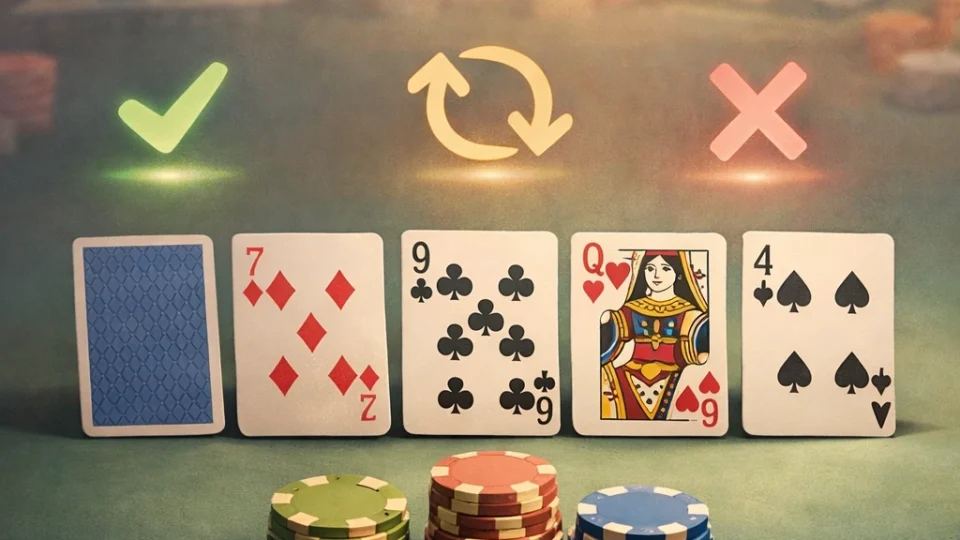
Mississippi Stud payouts at a glance
Mississippi Stud is settled from the final five-card poker hand, but the posted paytable at the table is what determines the payout. The published awards below cover the hand ranks supported by the available table information; they should not be read as a complete paytable for every possible hand.
A royal flush pays 500 to 1. A straight flush pays 100 to 1, four of a kind pays 40 to 1, and a full house pays 10 to 1. At one casino table, a pair of jacks, queens, kings or aces pays 1 to 1.
Those figures are payout odds, not a single prize attached to the hand. If more than one wager remains live when the cards are complete, the applicable odds are applied to each active wager. That is why the size and timing of the street bets matter as much as the final hand rank.
Which final hands win, push or do not qualify
The qualifying line is an important part of reading a Mississippi Stud paytable. On one documented table, a pair of jacks or better is a winning result. Pairs of sixes through tens push, meaning the wager is returned rather than paid as a win or collected as a loss.
That distinction makes a final pair different from a conventional poker showdown. A pair may be enough to avoid a loss without producing a profit, while a higher pair can receive the listed even-money payout. The top poker hands then move onto the larger published awards, from a full house through a royal flush.
Do not assume that every Mississippi Stud table uses the same pair threshold. Another casino guide describes a pair of sixes or better as a winning hand, so the exact qualifying point is not uniform across the material reviewed. The table in front of you is the rule that matters for that game.
It is also not possible to set out a definitive outcome here for every lower-ranking hand. The published material does not establish the full treatment of high-card hands, pairs below sixes, or every hand rank between a full house and a high pair. Rather than filling those gaps with a generic poker assumption, check the displayed paytable before playing.
How payout odds apply to the ante and street wagers
- Start with the ante. An ante wager gives the player two private cards. Three community cards are then dealt face down for later reveals.
- Choose at third street. Before the first community card is turned over, the player can fold or make a third-street wager worth one to three times the ante.
- Repeat the decision twice. After the first community card, the player may fold or place a fourth-street wager of one to three times the ante. After the second card, the same choice applies to the fifth-street wager.
- Settle what remains. Once the final community card is revealed, the final five-card hand resolves every wager still in action. For a winning hand, the ante and each active street wager are paid at the same listed payout odds.
Folding ends the hand and removes later settlement from consideration. Staying in means the relevant wager remains exposed to the final result, with each live bet assessed separately at the hand’s applicable paytable rate.
Casino variations: progressive jackpots and side wagers
The base Mississippi Stud paytable is not necessarily the only betting option on a casino floor. One casino offering includes a progressive-jackpot feature that gives players a chance to share a jackpot stated as more than $500,000. That feature is separate from the ordinary base-hand payout schedule.
Another casino offers an optional 3-Card Bonus wager alongside the main game. It is based on the three community cards and pays on a pair or better under that side bet’s rules. It should not be confused with the final five-card Mississippi Stud hand.
The leading base awards for royal flush, straight flush, four of a kind and full house match across two published casino tables. Beyond those ranks, as well as for jackpot terms, side-bet rules and any payout caps, rely on the posted information for the specific table being played.
Using the paytable to read a final return
The practical way to read a Mississippi Stud result is to separate two questions: what hand was made, and which wagers survived to the end of the hand. First identify the final five-card poker hand. Then find that hand on the table’s posted paytable. Finally, apply the listed odds to the ante and to every third-, fourth- and fifth-street wager still in action.
For example, suppose a player has kept the ante and all three street wagers live. If the final hand is a royal flush on a table displaying 500 to 1, the ante and each of those active street wagers are settled at 500 to 1. It is not a case of assigning the 500-to-1 award only to the original ante while ignoring the later wagers.
The same principle applies at lower listed awards. A full house on a table showing 10 to 1 is settled at 10 to 1 on each live wager. If the player folded before a later betting round, that unavailable wager cannot be part of the final settlement because it was never placed.
For pair outcomes, slow down and read the qualifying line as carefully as the payout column. A high pair may be a paid win, while a middle pair may push on some tables. Since documented tables do not necessarily use the same threshold, the safest calculation begins with the actual paytable and rules displayed for the game.
Optional jackpots and bonus wagers belong in their own calculation. They may use different cards, qualifying rules and payout arrangements from the base game. The trade-off is simple: a larger or additional feature may change what is at stake, but it does not alter the need to settle the core ante and active street wagers according to that table’s published Mississippi Stud paytable.